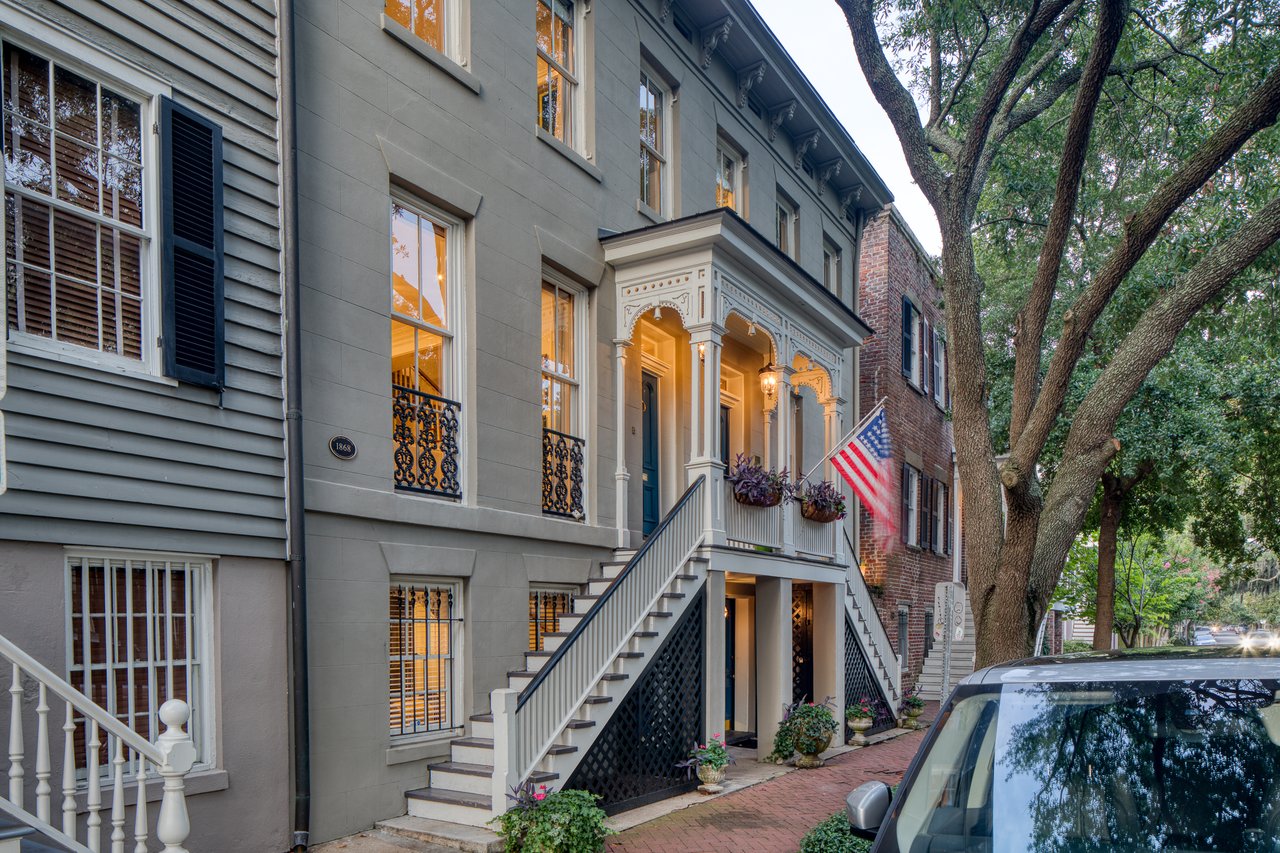
Short-Term Rental Rules in Savannah's Historic District
Buyer Resources, Investment Real Estate Liza DiMarco July 24, 2026
Buyer Resources, Investment Real Estate Liza DiMarco July 24, 2026
Yes, but with real restrictions. Savannah permits what it calls Short-Term Vacation Rentals (STVRs) — an entire dwelling unit rented for 30 days or less — only within a defined STVR Overlay District covering the Downtown, Victorian, and Streetcar (Thomas Square/Mid-City) local historic districts, plus certain business and agriculture zones elsewhere. Within the Downtown and Victorian Historic Districts specifically, the city caps non-owner-occupied STVRs at 20% per ward — once that cap is reached, new non-owner-occupied certificates stop until one opens up, and only owner-occupied properties can still apply.
By Liza DiMarco | July 24, 2026
A lot of out-of-state buyers assume Savannah works like any other tourist town — buy a cute historic house, list it on Airbnb, done. It's more complicated than that, and it's worth understanding the actual framework before you write an offer with short-term rental income baked into your numbers.
Savannah doesn't allow short-term rentals citywide. They're confined to the Short-Term Vacation Rental Overlay District, which covers the Downtown Historic District, the Victorian District, and the Streetcar (Thomas Square/Mid-City) Historic District, along with a handful of business and agriculture zoning classifications outside that overlay. If a property sits outside this overlay and outside those specific commercial zones, it generally can't be legally operated as a short-term rental, regardless of how good a listing photo it would make.
Within the Downtown and Victorian Historic Districts, Savannah caps non-owner-occupied STVRs at 20% of properties per ward. Once a ward hits that cap, new non-owner-occupied applications go onto a waiting list, processed first-come, first-served as spots open up. This is the single biggest constraint for pure investment buyers: in the most desirable, highest-demand wards, the cap may already be reached, meaning a straightforward investment purchase might not be able to get a new certificate at all.
Owner-occupied properties are treated differently and aren't subject to the same cap in the same way — if you're planning to live in the home part-time and rent it the rest of the time, your path to a certificate is generally more straightforward than a pure investment purchase.
Grandfathering matters here too. STVRs operating before September 28, 2017 have protections from the cap. If you're buying a property that already holds an active, grandfathered STVR certificate, that status is not automatically transferable — the new owner must apply for their own certificate, generally within six months of the purchase, to preserve continuity rather than getting placed behind the cap.
Properties in the Streetcar Historic District zoned TN-2 face an additional requirement: the parcel must have two or more dwelling units, with at least one owner-occupied. This effectively rules out single-family homes in this specific zoning designation from operating as a standard short-term rental unless the ownership structure fits that mold.
Operating an STVR in Savannah requires an STVR Certificate, a Business Tax Certificate through the city's Revenue Department, and a separate application for each individual property — you can't cover multiple properties under one certificate. Certificates are non-transferable, which matters if you're buying a property with an existing STVR history, as noted above.
Application and renewal fees have generally run around $150 per year, though it's worth confirming the current fee directly with the city before budgeting, since municipal fees are adjusted periodically. New applicants are also required to notify all adjacent property owners of record before approval, providing proof of that notification to the city.
Beyond the permit itself, operating STVRs come with day-to-day operating rules: occupancy limits based on bedroom count (verified against building code compliance, not just what's advertised), a general expectation of one off-street parking space per rental unit with some exceptions in the Historic District, and enforced quiet hours overnight. These operational rules exist on top of the permitting and cap system, and violations can result in fines separate from any cap or certificate issues.
Savannah actively cross-references short-term rental listings against its permit database to identify unregistered operators, and the city maintains both a complaint hotline and an online complaint portal for neighbors to report suspected violations. This isn't a market where an unpermitted listing is likely to fly under the radar for long — worth factoring into any investment decision that assumes operating without a certificate is a viable workaround.
Given how much regulatory complexity is packed into Savannah's STVR system — the overlay district, the ward cap, permit renewals, occupancy verification, and active city enforcement — a property management company that specializes specifically in short-term vacation rentals is often the most practical way to handle both the licensing process and the ongoing operation of the property. A specialized manager typically has direct experience with Savannah's permit application and renewal process, established relationships for cleaning and maintenance turnaround between guests, and a working understanding of the city's compliance requirements, which reduces the risk of an accidental violation. For owners who don't live in Savannah full-time, this is usually the difference between a property that runs smoothly and one that becomes a constant source of phone calls. Two established local companies worth knowing — Lucky Savannah and South Key Management — both specialize in Savannah STVR licensing and property management specifically.
Pricing is typically handled through dynamic pricing software rather than a single flat nightly rate. These tools automatically adjust pricing based on demand trends, seasonality, nearby comparable listings, and local events — a property might rent for a modest rate on a quiet Tuesday in July and command a significant premium during St. Patrick's Day weekend or a busy SCAD graduation weekend. Most professional management companies build this kind of dynamic pricing into their service, since it generally produces stronger overall revenue than setting one rate and leaving it unchanged year-round.
Not every eligible property performs the same once it's actually operating. A few patterns hold up consistently in Savannah's market:
One thing that catches out-of-town buyers off guard: a top-performing STVR is, by definition, usually booked. Unlike a vacant listing you can tour on short notice, a successful short-term rental generates its returns by staying occupied — which means the best-performing properties are often the hardest ones to actually get inside.
If you're flying in for a few days to look at Savannah properties, don't plan on walking into a strong STVR the way you would a standard resale. Booking conflicts, guest checkout timing, and cleaning windows all limit access, and a same-day or last-minute request to view an occupied rental is one of the more common sources of frustration for out-of-state buyers on a tight visit.
The better approach is planning ahead through a realtor with an established track record specifically in the Historic District's STVR market. An experienced local agent can find out well in advance when a property has an opening between bookings, and in some cases can arrange a hold on the calendar so a serious buyer has a real window to view it in person. Coordinating this kind of access takes local relationships and lead time — exactly the reason a last-minute, unplanned visit so often leads to disappointment.
Can I run an Airbnb in Savannah's Historic District?
Only within the designated STVR Overlay District, and only with a valid STVR Certificate. The Downtown and Victorian Historic Districts are subject to a 20% per-ward cap on non-owner-occupied rentals, so availability depends on whether that ward has open capacity.
What is Savannah's 20% ward cap for short-term rentals?
It's a limit on how many non-owner-occupied properties per ward can hold active STVR certificates in the Downtown and Victorian Historic Districts. Once a ward reaches that cap, new non-owner-occupied applications go on a waiting list rather than being approved outright.
Does an existing STVR permit transfer when I buy the property?
No. STVR certificates are non-transferable. A new owner must submit their own application, generally within six months of purchase, to maintain continuity and any grandfathered protections the property may have held.
How much does an STVR permit cost in Savannah?
Fees have generally run around $150 per year, though this should be confirmed directly with the city, since municipal fees can change.
Is Savannah actively enforcing its short-term rental rules?
Yes. The city cross-references listing platforms against its permit database to identify unregistered rentals and maintains both a complaint hotline and an online portal for reporting suspected violations.
Can you make a lot of money running a short-term rental in Savannah?
Not typically as a large profit center. Once permitting, management, and operating costs are factored in, most Savannah STVR owners use rental income to help offset the cost of ownership — property taxes, insurance, and maintenance — rather than as a standalone high-margin investment.
Can I tour an active short-term rental in Savannah before buying it?
It's possible, but it takes planning. Top-performing STVRs are usually booked most of the time, so viewing one typically requires coordinating around checkout dates and cleaning windows rather than a same-day request. An agent experienced in Savannah's STVR market can often identify an upcoming opening or arrange a hold on the calendar, which is why planning a visit well in advance — rather than trying to tour on short notice during a quick trip — leads to a much better outcome.
If a short-term rental purchase is part of your Savannah strategy, the ward cap and permit history need to be checked before you make an offer, not after. That's exactly the kind of due diligence I build into the process for investment-minded clients.
Liza DiMarco | Compass Savannah
About Liza DiMarco Marketing Specialist
Liza is a dedicated, passionate, and market-savvy professional who puts her clients' satisfaction before all else. Her attention to detail, superior people skills, and broad knowledge of the real estate industry as a whole, along with her pure determination to indulge her clients with first-class service sets Liza apart from the rest of the Real Estate Agents.
Liza is the Savannah and coastal Georgia Network Partner in The Private Client Network — an invitation-only collective of 300+ top-producing Compass advisors across 80+ luxury markets nationwide. For clients buying or selling across state lines, it means one trusted relationship that follows them anywhere.

Local Guides, Lifestyle
The best dog parks, dog-friendly restaurants, and the only real dog beach near Savannah's Historic District

Luxury Real Estate
Why this market rewards deep local knowledge over general real estate experience — and what that actually looks like in practice
Buyer Resources, Investment Real Estate
What investors actually need to know before buying a Savannah property to rent short-term
Relocating to Savannah
Best $1M+ Savannah neighborhoods near the Historic District for NYC, Boston, Chicago, and DC buyers relocating south — Ardsley Park, Isle of Hope, and more.
Navigate the intricacies of real estate negotiations with confidence. Liza's unparalleled negotiation skills have consistently delivered optimal outcomes for her clients. Trust in her ability to secure the best deals, whether you're buying or selling.